
Is 4 mg the “Sweet Spot” for Retatrutide?
The 12 mg results grabbed the headlines, but the 4 mg data may tell the more useful story: substantial average weight loss with fewer people stopping because of side effects.
Retatrutide remains investigational and is not FDA approved. The trials also have not established 4 mg as the exact dose at which the glucagon receptor “switches on.” This article explores the data, not a personal dosing protocol.
Everyone noticed 12 mg. But 4 mg deserves a second look.
The highest retatrutide dose produced the biggest number in the Phase 3 TRIUMPH-1 trial: an average body-weight reduction of 28.3% at 80 weeks. That is the sort of result that walks into a headline without knocking.
The 4 mg group, however, lost an average of 19%—about 47 pounds from the trial’s average starting weight. It was not the largest result, but it was far from a consolation prize.
The more interesting part may be what happened when tolerability entered the picture. Only 4.1% of the 4 mg group stopped treatment because of adverse events, compared with 6.9% at 9 mg, 11.3% at 12 mg and 4.9% with placebo.
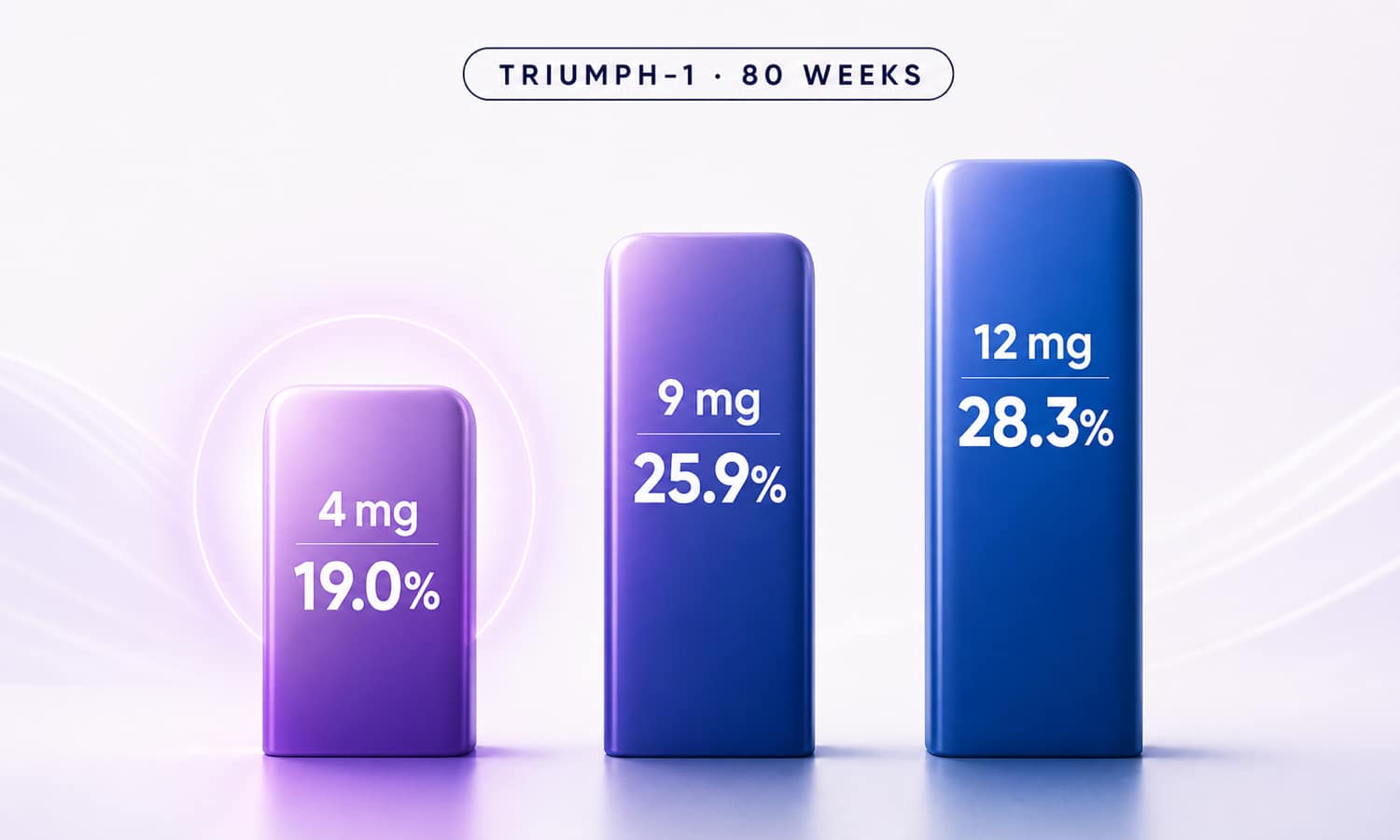
Average change at 80 weeks
Discontinuation rate
Three receptors—but not three identical switches
Retatrutide is a single molecule designed to activate GIP, GLP-1 and glucagon receptors. The glucagon component is what separates it from the dual agonist tirzepatide.
GIP
Supports glucose-dependent insulin signaling and contributes to the broader metabolic response.
High relative potencyGLP-1
Influences appetite, fullness, energy intake, gastric emptying and glucose regulation.
Appetite + glucoseGlucagon
The differentiating pathway, linked in preclinical work with energy expenditure, liver signaling and fat metabolism.
Key differentiator
Laboratory assays show that retatrutide activates the GIP and GLP-1 receptors at lower concentrations than the glucagon receptor. That has inspired a reasonable theory: perhaps glucagon-related effects become more noticeable as the weekly dose rises, with 4 mg representing an interesting point on the curve.
But receptors do not work like light switches, and the glucagon receptor does not punch a time clock the moment someone reaches exactly 4 mg. Cell-assay potency values cannot be translated directly into a weekly human dose.
The careful conclusion is that 4 mg may be a transition point—not a proven biological threshold.

What changes as the dose rises?
Several effects become more noticeable across the retatrutide dose range. They are interesting clues, but none can identify glucagon activity on its own.
Dysesthesia
Tingling, burning or unusual skin sensitivity occurred in 5.1% of the 4 mg group, 12.3% at 9 mg, 12.5% at 12 mg and 0.9% with placebo in TRIUMPH-1. Most cases were mild or moderate.
Dose-related does not automatically mean glucagon-caused.Heart rate
The Phase 2 obesity trial reported dose-dependent increases in heart rate. The increases peaked around week 24 and then declined.
Heart-rate changes can have multiple causes and do not identify one receptor.Liver fat
In a small Phase 2a substudy, average liver fat fell by 42.9% with 1 mg and 57% with 4 mg at 24 weeks. Reductions exceeded 80% with 8 mg and 12 mg.
Weight loss and all three pathways may contribute to this result.
The tolerability data matter more than the receptor theory
The receptor-threshold idea is still speculative. The Phase 3 efficacy and discontinuation numbers are much more concrete.
The 4 mg dose was not side-effect-free. In TRIUMPH-1, nausea affected 28.6% of participants, diarrhea 25.2%, constipation 23.8% and vomiting 10.6%.
So the fact that adverse-event discontinuation was numerically lower than placebo does not mean taking 4 mg felt like taking nothing. It means relatively few people found the effects severe or persistent enough to stop treatment.
That distinction matters. A medication can look spectacular on a spreadsheet, but it cannot help someone who cannot remain on it. Long-term treatment has to work in real life, where people have jobs, families and very limited enthusiasm for spending Tuesday in a committed relationship with the bathroom.

So, is 4 mg really the sweet spot?
Maybe for some people—but the evidence does not establish it as the universal best dose. Someone needing the greatest possible weight reduction may benefit more from 9 mg or 12 mg. Someone who reaches an appropriate target at 4 mg may have little reason to accept the additional side-effect burden of going higher.
What the data clearly support is that 4 mg was an effective destination in its own right: nearly 20% average weight loss, only one escalation step after the 2 mg starting dose and a 4.1% adverse-event discontinuation rate.

Research and trial references
This article uses peer-reviewed research, registered trial information and current results reported by retatrutide’s developer.