
GLOW Blend
GLOW usually combines GHK-Cu, BPC-157 and TB-500 in one fixed-ratio vial. Each ingredient has a different evidence base, while the three-way blend has no established clinical protocol.
Three ingredients, three separate evidence streams
A “70 mg GLOW” label is incomplete unless the amount and chemical form of every ingredient are explicit.
Skin and matrix story
GHK-Cu is linked to copper signaling and matrix biology, mainly through laboratory and topical work.
Repair story
BPC-157 is marketed around gastrointestinal and musculoskeletal animal models with little direct human confirmation.
Migration story
TB-500 claims frequently borrow from the larger thymosin beta-4 molecule rather than the specific fragment.
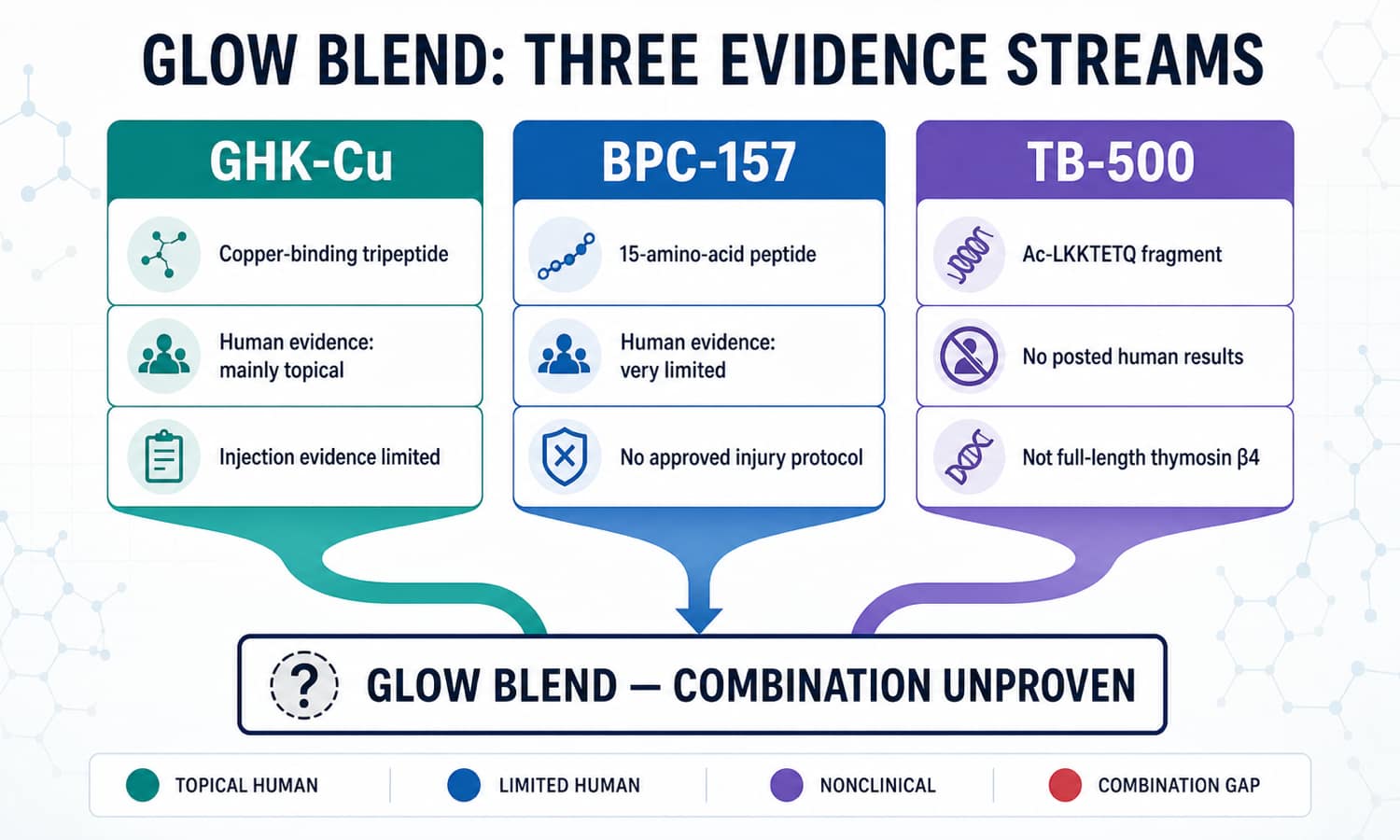
Three incomplete streams do not become one strong stream
No controlled human study has tested the exact three-component formula, ratio and route sold as GLOW.
Small topical evidence
A 13-completer cosmetic study after laser resurfacing found no objective between-group improvement in redness, wrinkles or overall skin quality. It cannot validate injection.
Very limited human reports
Small uncontrolled reports do not establish a subcutaneous recovery dose, structural healing or long-term population safety.
No posted human results
FDA's review found no human exposure studies for the specific fragment. Animal, in-vitro and full-length Tβ4 work are not human TB-500 outcomes.
What can be said
- Each ingredient has a plausible research narrative
- Evidence differs by molecule and route
- A blend locks all three exposures together
- Direct testing is needed to claim synergy
What remains unproven
- Faster tendon, wound or surgical recovery
- Injectable skin, hair or anti-aging benefits
- An effective or safe fixed ratio
- Superiority to rehabilitation or any component alone
How GLOW is commonly used
These ranges describe online practice—not approved doses or validated treatment plans.
GHK-Cu pattern
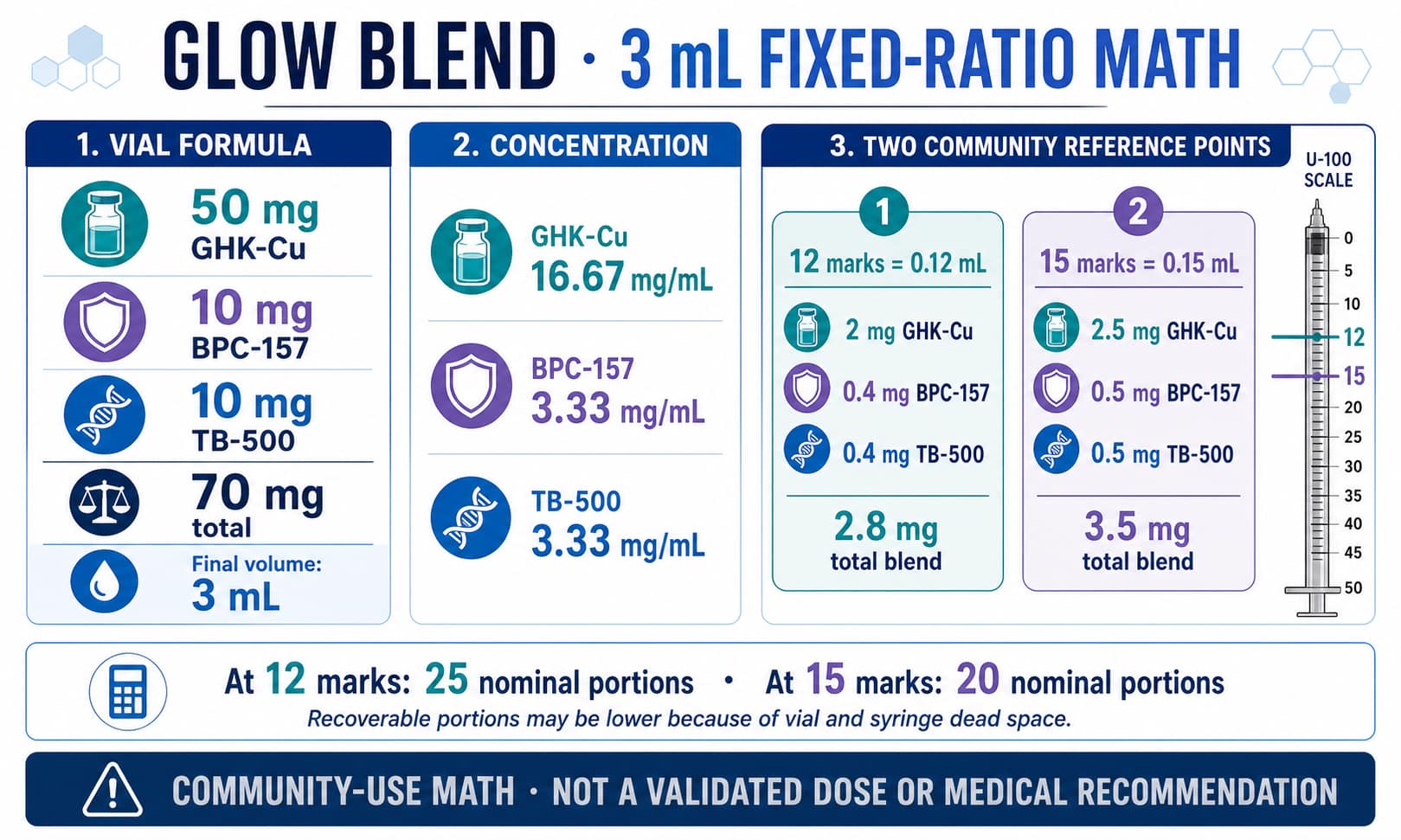
Many users aim around 2–2.5 mg. That is a community target, not a clinically established optimum, and topical evidence does not establish injectable safety.
BPC-157 pattern
Users may inject “near” an injury, although local targeting and improved outcomes have not been demonstrated.
TB-500 pattern
A daily fixed blend converts that intermittent community pattern into daily smaller exposure without human validation.
Three milliliters makes the common targets easy to audit
50:10:10 mg in 3 mL
The separate concentrations are 16.67 mg/mL GHK-Cu and 3.33 mg/mL each of BPC-157 and TB-500.
What the calculation assumes
- The vial truly contains 50:10:10 mg
- Final volume is 3 mL—not merely an approximate amount added
- One U-100 mark equals 0.01 mL of volume
- All three components are uniformly dissolved and compatible
- The label's mass basis is accurate
Nominal portions
At 0.12 mL, 3 mL provides 25 nominal portions. At 0.15 mL, it provides 20. Recoverable amounts may be lower due to dead space.
No universal shelf life
Raw-powder freezer claims do not establish stability for a mixed three-component vial.
Blue is not sterility
Color cannot rule out contamination, endotoxin, degradation, particles or incorrect concentration.
Extra caution is warranted with
- Active or recent cancer or unexplained mass
- Pregnancy, breastfeeding or planned conception
- Infection, open wound or recent procedure
- Severe allergy or prior peptide reaction
- Liver, kidney, vascular or copper-metabolism disease
Seek urgent care for
- Breathing trouble, facial swelling, hives or fainting
- Chest pain, severe headache or neurologic symptoms
- Rapidly spreading redness, pus or severe joint pain
- Fever, confusion or signs of bloodstream infection
GLOW Blend FAQs
What is GLOW Blend?
A community nickname usually describing GHK-Cu, BPC-157 and TB-500 in one vial.
Is there a standard ratio?
No. A 50:10:10 mg formula is common online, but no ratio has been clinically validated.
Is 2–2.5 mg GHK-Cu optimal?
It is a frequently discussed community target, not a clinically established optimum for injectable GHK-Cu or GLOW.
Has GLOW been tested in people?
No controlled human study of the three-way blend was identified.
Can one ingredient be reduced?
Not in a premixed vial. Withdrawing less reduces all three ingredients proportionally.
Is GLOW the same as KLOW?
Community shorthand usually treats KLOW as GLOW plus KPV, but neither name defines a universal recipe.
Research behind this page
Three plausible stories do not make one proven blend.
Start with exact identities, track three separate exposures, and require direct outcomes before accepting synergy claims.
Explore the Research Library