Beginner guide
Animal Studies vs Human Trials
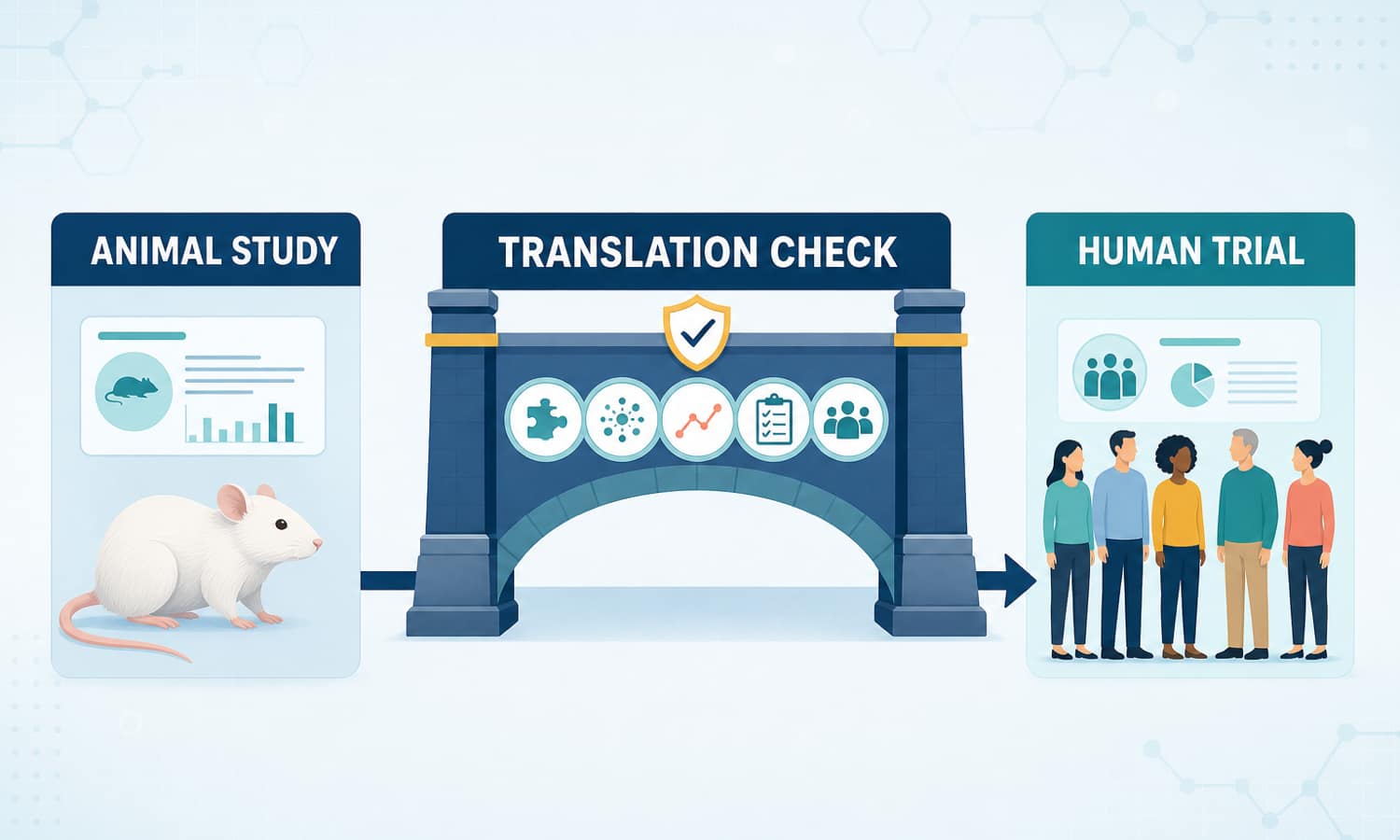
Animal research can reveal a promising biological signal. Human trials ask whether that signal becomes a tolerable, meaningful result in people. The difference is a translation problem—not a contest between “useful” and “useless.”
Animal evidence is a bridge entrance, not a human verdict.
An animal study can test a mechanism, control variables tightly, and identify early biological or safety signals in a living system. It cannot prove that a peptide is safe or beneficial for people. Only well-designed human research can directly answer human questions—and an early human trial is still only one step, not final proof.
Two evidence lanes
They answer different versions of the question
“Did it work?” is too vague. First ask what kind of work the experiment was built to detect.
Can this idea do something in this model?
Researchers can control diet, age, genetics, housing, timing, and exposure more tightly than in people. That makes a well-chosen model useful for isolating a mechanism or watching how a whole living system handles an intervention.
- Explores biological pathways and target activity
- Measures absorption, distribution, metabolism, and toxicity signals
- Helps decide whether further research is justified
What happens in the people actually studied?
Clinical trials test an intervention under a written protocol in human participants. Early trials often emphasize how the body handles it and what adverse effects appear; later trials may test benefit against a control in a defined population.
- Directly observes human exposure and tolerability
- Can measure symptoms, function, events, and quality of life
- Can compare benefits and harms in the target population
What each can establish
Use the right evidence for the right claim
A model represents selected features of biology or disease. It is not a miniature person, and a clinical trial is not automatically a complete picture of everyone.
Five bridge bolts
Before carrying a result from animals to people, check five things
Translation is strongest when every step is explicit. A missing step does not erase the study; it limits the claim.
Model fit
Which feature of the human condition does the species or disease model reproduce—and which features does it leave out?
Exposure
Did the substance reach the relevant tissue, and could human absorption and metabolism produce a comparable exposure?
Outcome
Was the result a molecular marker, animal behavior, tissue change, symptom, function, or meaningful health event?
Study quality
Were groups suitable, allocation randomized, assessors blinded where possible, exclusions explained, and results fully reported?
Repeatability
Was the result repeated across experiments, laboratories, models, or human studies—or is the headline resting on one finding?
Headline translator
Shrink the claim until it fits the experiment
This fictional example contains no real peptide or dosing advice. It shows how a true observation can become an unsupported human promise.
A 60-second reading check
Five questions for the next animal-study headline
What exactly was studied?
Name the species, model, product, comparator, route, duration, and number analyzed.
What exactly changed?
Separate a laboratory marker or animal behavior from a human symptom, function, or health event.
How solid was the experiment?
Look for randomization, blinding, justified sample size, clear exclusions, effect sizes, and uncertainty.
What translation step is missing?
Check human exposure, early safety, controlled benefit, longer follow-up, and independent replication.
Is the wording calibrated?
“Shows in mice,” “supports a mechanism,” and “justifies further study” are different from “works in people.”
What would change your confidence?
Decide whether you need another model, a registered human trial, a suitable control, or a broader evidence review.
Quick answers
Animal studies and human trials: FAQs
If a peptide works in mice, is it likely to work in humans?
The result makes a human effect possible, not probable by itself. Confidence depends on model fit, exposure, outcome relevance, study quality, replication, and later human evidence.
Are animal studies only about safety?
No. They can investigate normal biology, disease mechanisms, target activity, exposure, and potential benefit as well as toxicity. Their conclusions remain specific to the model and experiment.
Is any human study stronger than an animal experiment?
No. “Human” describes the participants, not the rigor. A case report or tiny uncontrolled study may be very weak evidence of benefit. Design, comparator, bias control, outcome, duration, and reporting still matter.
Does a Phase 1 trial prove effectiveness?
Usually not. Early trials commonly focus on how an investigational product behaves in people, tolerability, and short-term adverse effects. Any efficacy signal is generally preliminary and must be tested in later, suitable trials.
Does human-trial evidence mean a peptide is approved?
No. Investigational products are studied in humans before approval decisions, and many never become approved treatments. Keep research status, regulatory status, product identity, and evidence of benefit as separate questions. See Research Peptides vs Prescription Peptides.
Keep learning