
Beginner guide
Mass Spectrometry Explained
Mass spectrometry turns molecules into charged particles, sorts their signals by mass-to-charge ratio, and builds a spectrum. It can provide powerful identity evidence—but the result is only as good as the method, reference, and interpretation.
Think “molecular barcode reader,” not a camera.
A mass spectrometer does not look at an intact vial and announce what is inside. A prepared sample enters the instrument, molecules are converted into ions, those ions are separated according to mass-to-charge ratio (m/z), and a detector records their signals. Matching the observed pattern to a justified expectation can support identity, reveal certain variants, and help characterize impurities.
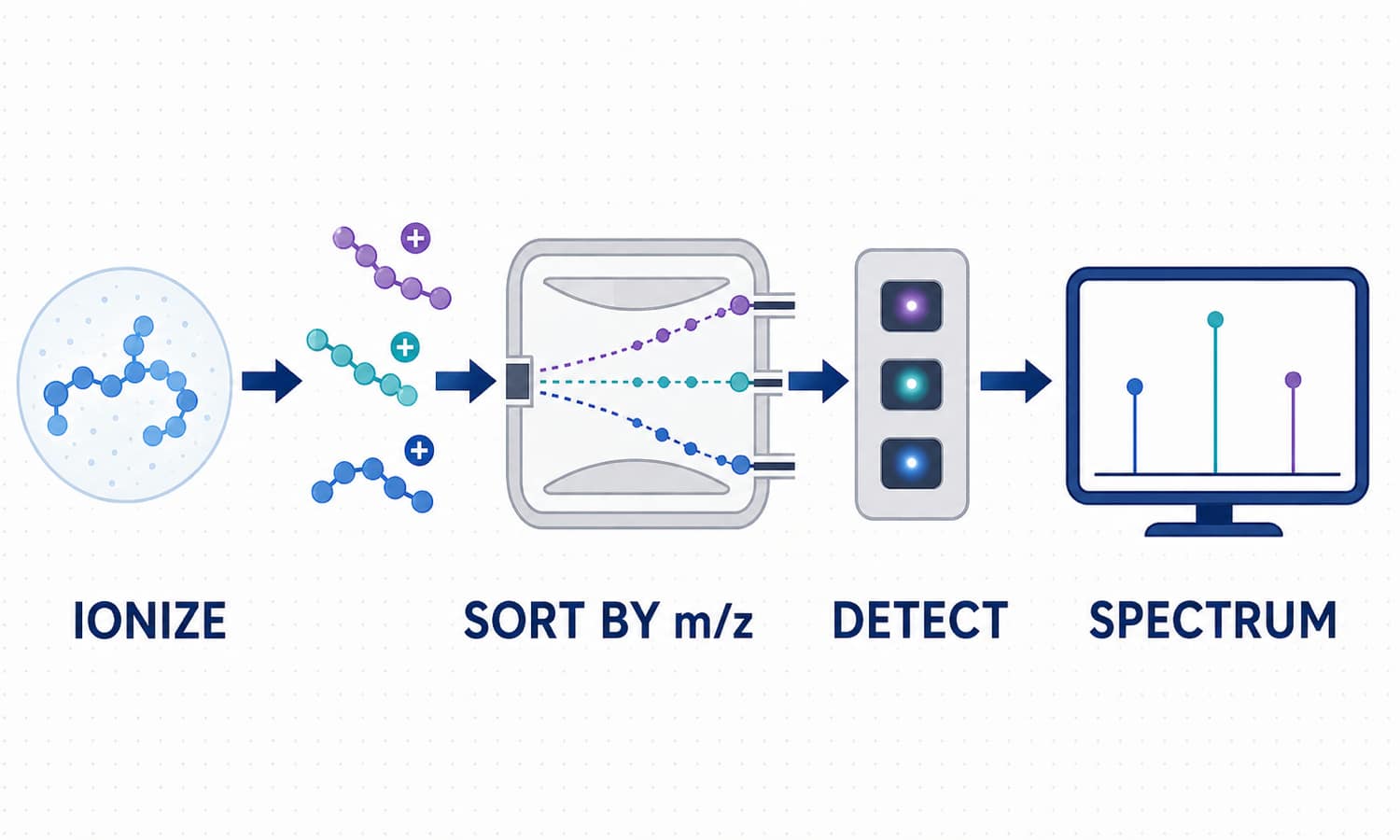
Four jobs, one measurement
Follow the ion, not the bottle
The simplest mental model is a four-stop journey. Each stop can affect what appears—or does not appear—in the final result.
Prepare and ionize
The sample is dissolved or otherwise introduced, then molecules gain or lose charge so the instrument can move them.
Separate the ions
An analyzer sorts ion signals by m/z. Different analyzer designs use different physical routes and performance levels.
Detect the signals
The detector records arriving ions. Signal strength reflects response under those conditions, not automatically the amount in the original vial.
Interpret the spectrum
Software assigns peaks, charge states, isotope patterns, candidate masses, fragments, and matches under defined rules.
Reading the picture
A mass spectrum has two main axes
Unlike an HPLC chromatogram, which usually plots detector signal over time, a mass spectrum plots ion signal against m/z.
A simplified mass spectrum
A tall line means a stronger detected ion signal in that spectrum. It does not, by itself, prove identity, purity percentage, or vial content.
m/z
Mass number divided by charge number. A molecule carrying more than one charge can appear at an m/z much lower than its neutral molecular mass.
Intensity
The recorded response. Ionization efficiency, suppression, instrument settings, transmission, and detector response can all influence it.
Isotope pattern
A small cluster around an ion. Natural isotopes create a pattern that can help establish charge, composition, and confidence when resolution is sufficient.
Why one peptide can make several peaks
Charge changes where the signal appears
Electrospray ionization commonly gives peptides more than one possible charge state. The same peptide may therefore produce a family of m/z peaks.
Deconvolution translates the pattern
Software can combine compatible charge-state signals to estimate a neutral mass.
That translation depends on correct charge assignment, calibration, peak selection, and rules for adducts and isotopes. Ask whether the report shows observed m/z, assigned charge, calculated mass, and allowed error.
An evidence ladder
“The mass matches” is useful—but not always the finish line
Two molecules can share the same nominal mass, and some sequence changes can be difficult to distinguish with an intact-mass result alone. Stronger claims need stronger discrimination.
Intact-mass match
Does the deconvoluted mass agree with the expected peptide within a stated tolerance?
- Fast identity support
- Can flag large additions, losses, or truncations
- Does not fully prove sequence order
High-resolution detail
Accurate mass and resolved isotope patterns can narrow possible elemental compositions and separate close signals.
- Resolution and mass error matter
- Calibration must be acceptable
- Close or co-eluting species remain method-dependent
Tandem MS (MS/MS)
A selected precursor ion is fragmented, creating a pattern that can support sequence or structural assignments.
- Adds location-related evidence
- Needs justified fragment interpretation
- Reference materials and orthogonal tests can strengthen confidence
Why LC–MS is powerful
Chromatography and mass spectrometry answer different coordinates
Liquid chromatography can first separate components over time; the mass spectrometer then records m/z information at those times.
Chromatography asks “when?”
- When did a component leave the column?
- Did nearby components separate?
- What peak area did the detector integrate?
Boundary: retention time alone is rarely a unique molecular identity.
Mass spectrometry asks “which ion signal?”
- Which m/z values appeared at that time?
- Do charge and isotope patterns fit?
- Do fragments support the proposed structure?
Boundary: ion response is not automatically a purity or amount measurement.
A practical report check
Read an MS claim in five passes
Start with the full certificate of analysis or laboratory report, then trace the claim back to the evidence.
Quick answers
Mass spectrometry FAQs
Does the highest peak identify the main ingredient?
Not necessarily. The tallest signal is the most intense detected ion under those conditions. Different molecules ionize and transmit differently, and one molecule may produce several ion forms. Identity comes from a justified match, not height alone.
Is molecular mass the same as m/z?
No. Molecular mass describes the neutral molecule; m/z describes an ion’s mass number divided by its charge number. A multiply charged peptide can appear at several lower m/z values. Deconvolution estimates the neutral mass from compatible signals.
Can intact-mass MS prove the exact amino-acid sequence?
Often not by itself. Different structures may share the same or very similar mass. Tandem MS, reference comparison, chromatography, and other orthogonal procedures may be needed for the claimed level of identification.
Why might two laboratories report slightly different masses?
They may use different ionization conditions, analyzers, calibration, isotope selection, charge assignment, adduct rules, deconvolution software, or ways of reporting average versus monoisotopic mass. Compare methods and tolerances before comparing numbers.
Does “LC–MS tested” mean a material is safe to use?
No. It names an analytical platform, not a safety conclusion. The report still needs sample traceability, a fit-for-purpose method, qualified interpretation, acceptable controls, and separate evidence for microbiological, clinical, manufacturing, and regulatory questions.
Keep learning
Sources and related TalkingPeps guides
Related roadmap pages
Selected authoritative sources
- NIST: Mass Spectrometry for the Characterization of Polymers
- IUPAC Gold Book: Mass-to-Charge Ratio
- FDA / ICH Q2(R2): Validation of Analytical Procedures
- FDA: ANDAs for Certain Highly Purified Synthetic Peptide Drug Products
- Wilm: Principles of Electrospray Ionization
- Zeng et al.: LC-HRMS for Peptide Drug Quality Control