
Beginner guide
What Does Peptide Purity Mean?
A purity percentage is not a universal quality score. It has meaning only when you know what was measured, how it was measured, and which materials the method could—and could not—see.
“99% pure” usually answers one narrow laboratory question.
On many peptide reports, purity means the relative area of the target peak in an HPLC chromatogram. In plain English: among the peaks detected and counted under that method, about 99% of the signal was assigned to the main peptide peak. It does not automatically mean that 99% of the powder’s weight is peptide, that the vial contains the labeled amount, or that it is sterile, safe, effective, or approved.
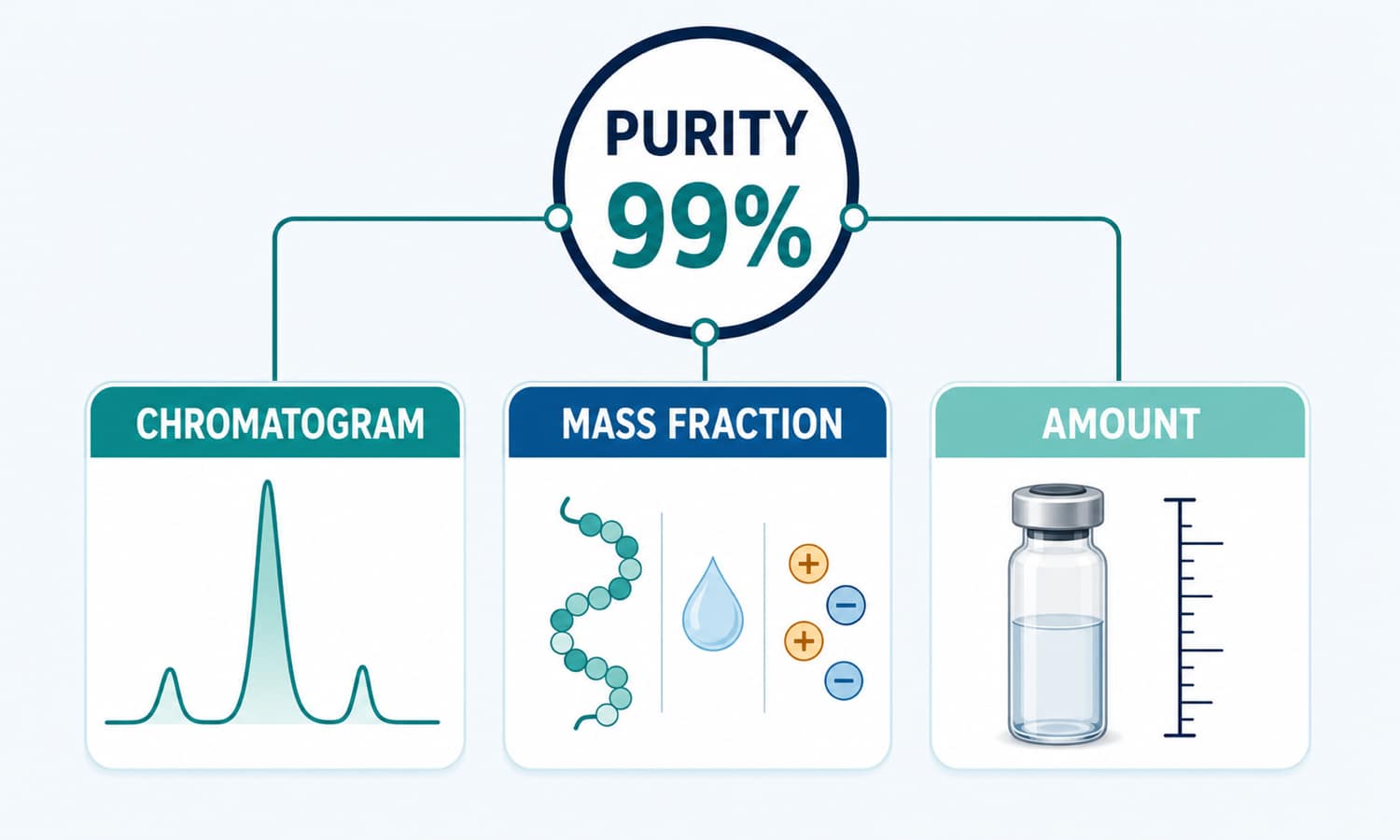
The three-lens test
One word, three different questions
People often use “purity” for three ideas that need different tests and different denominators.
Chromatographic purity
Question: how much of the integrated detector signal belongs to the target peak compared with the other counted peaks? Often reported as HPLC or UPLC area%.
Peptide mass fraction
Question: how much of the material’s total mass is the peptide itself? A mass-balance approach may separately account for related impurities, water, counterion, residual solvents, and inorganic residue.
Amount or strength
Question: how much target peptide is present per vial, milliliter, or other container? This needs a quantitative assay or another fit-for-purpose measurement—not a peak-area percentage alone.
What the chromatogram says
HPLC separates signals; it does not weigh every ingredient
High-performance liquid chromatography passes a prepared sample through a column. Components can leave the column at different times and produce peaks at the detector.
A simplified area% picture
A fictional worked example
Two correct percentages can describe the same sample
This made-up example is about measurement language, not a real product or acceptable specification.
Fictional reference material
The laboratory reports two results produced for different purposes.
What may sit outside the main peak
“Impurity” is not one single kind of thing
Synthetic peptides can carry several families of unwanted or separately measured material. No single routine chromatogram necessarily captures all of them.
Peptide-related material
- Shorter or longer sequences from synthesis
- Oxidized, deamidated, or otherwise degraded forms
- Isomers or closely related structures
- Aggregates or other variants, where relevant
Non-peptide material
- Water or moisture
- Counterions associated with the peptide salt
- Residual solvents or reagents
- Inorganic residue and other process-related material
Separate quality questions
- Identity and correct sequence
- Amount per container and uniformity
- Microbial quality, sterility, or endotoxins where applicable
- Particles, storage stability, packaging, and labeling
A practical reading filter
Use four checks before trusting the headline number
Read the underlying record or certificate of analysis, not just a product-page badge.
Quick answers
Peptide purity FAQs
Does 99% purity mean 99% of the powder is peptide?
Not if the result is HPLC area%. That percentage compares integrated detector signals under one method. Total powder mass can also include water, counterions, residual solvents, excipients, and material the detector did not measure. A mass fraction or quantitative content assay answers a different question.
Does a high purity percentage confirm the peptide’s identity?
No. A dominant chromatographic peak is not automatically the intended molecule. Identity needs fit-for-purpose evidence, which may include mass spectrometry and other complementary tests. See Mass Spectrometry Explained.
Why can two laboratories report different purity numbers?
They may use different columns, gradients, detectors, wavelengths, sample preparations, integration rules, reference materials, or calculations. Results are comparable only when the procedures and reporting basis are understood. See HPLC Testing Explained.
Is 98% or 99% “good enough”?
There is no universal beginner-friendly cutoff for every peptide and purpose. Suitability depends on the exact material, intended use, impurity identities and risks, validated method, and established specification. A percentage without that context cannot answer the question.
Does high purity mean a product is safe or FDA-approved?
No. Analytical purity is one quality attribute. It does not establish clinical safety, effectiveness, lawful marketing, manufacturing controls, or approval of a finished product. The distinction between a laboratory material and an approved medicine is covered in Research Peptides vs Prescription Peptides.
Keep learning
Sources and related TalkingPeps guides
Related roadmap pages
Selected authoritative sources
- FDA / ICH Q2(R2): Validation of Analytical Procedures
- FDA: ANDA Submissions for Certain Highly Purified Synthetic Peptide Drug Products
- FDA / ICH Q7: Good Manufacturing Practice Guidance for Active Pharmaceutical Ingredients
- FDA / ICH Q6A: Specifications, Test Procedures, and Acceptance Criteria
- USP scientists: Reference Standards to Support Quality of Synthetic Peptide Therapeutics
- NIST SRM 8327: Human C-Peptide certificate