
Complete Blood Count Explained
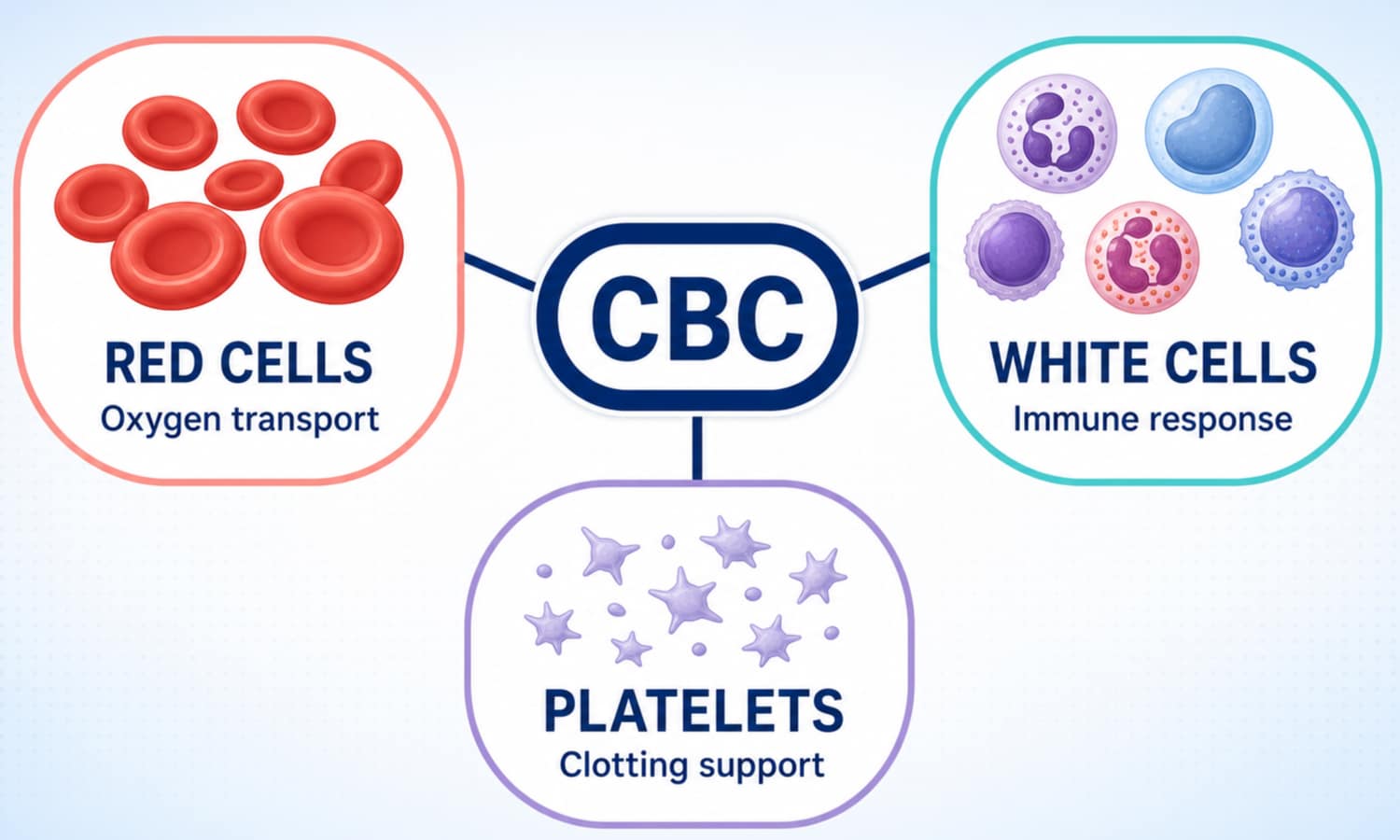
A CBC is not one test with one answer. It is a coordinated snapshot of the cells that carry oxygen, support immune defense and help stop bleeding.
The useful question: which group changed, do nearby markers agree, and could context explain it?
Read the CBC as three related groups
Most abbreviations belong to one of three practical questions. Start with the group, then examine the details.
Red-cell group
RBC count is cell number. Hemoglobin measures oxygen-carrying protein. Hematocrit is the blood proportion occupied by red cells. MCV is their average size.
White-cell group
WBC count is the total. A differential separates neutrophils, lymphocytes, monocytes, eosinophils and basophils, making the pattern more informative than the total alone.
Platelet group
Platelet count estimates how many cell fragments can help form a clot. Size measures such as MPV need the count and clinical setting for context.
Four numbers describe one delivery system
Hemoglobin carries oxygen. Hematocrit usually moves with it; cell count and MCV show whether number, size or both are involved.
A pattern is more useful than a lone flag.
How much oxygen-carrying protein? A low result is part of an anemia pattern; the CBC alone does not establish why.
What share of blood is red cells? Plasma volume matters, so dehydration can make it look higher.
How large is the average red cell? A low MCV can fit iron deficiency or inherited hemoglobin patterns; a high MCV can occur with B12 or folate problems, alcohol, liver or thyroid issues, and some medicines.
When the red-cell group is low
Low hemoglobin or hematocrit may suggest anemia. Blood loss, iron deficiency, reduced production and increased cell breakdown are possibilities—not conclusions. MCV and targeted nutrient or iron testing can narrow the question.
When the red-cell group is high
Higher hemoglobin or hematocrit can reflect dehydration, altitude, smoking, sleep-related low oxygen, testosterone exposure or a blood-production disorder. Persistence matters.
The differential tells you who changed
The differential reports the amount or percentage of each cell type. Absolute counts are often more useful because a percentage can shift when another type changes.
A raised count may accompany infection, inflammation, stress or certain medicines. A low count can follow medicines, chemotherapy, immune conditions or reduced marrow production. Cell type, severity, symptoms and trend determine urgency.
Count first, then ask why
Platelets help plug an injured vessel. The count alone does not describe how well they function.
Lower count
May reflect reduced production, increased destruction or collection in the spleen. Medicines, viral illness, immune conditions and pregnancy are possible contexts.
Higher count
Can react to infection, inflammation, blood loss or iron deficiency, or less commonly relate to a marrow disorder. Cause shapes next steps.
Symptoms matter
New unexplained bruising, pinpoint red spots, persistent nosebleeds or other bleeding should be discussed promptly, especially with a substantially abnormal count.
Six pieces of context can change the reading
Use your laboratory’s interval. Age, sex, pregnancy, altitude, method and clinical circumstances can change interpretation.
Hydration
Less plasma can concentrate red-cell measurements; excess fluid can dilute them.
Illness
Recent infection or inflammation can shift white cells and sometimes platelets.
Hard training
An intense session can temporarily alter white-cell counts and fluid balance.
Altitude
Longer exposure to lower oxygen can raise hemoglobin and hematocrit.
Medicines
Steroids, chemotherapy and other medicines may affect one or more cell groups.
Life stage
Menstruation, pregnancy, age and sex can affect the expected pattern.
Hematocrit deserves monitoring—not an automatic fix
Hormone communities watch hematocrit because testosterone therapy can increase red-cell production. Professional guidance supports monitoring, but a high result still needs context.
CBC trends around therapy
People compare hematocrit and hemoglobin while noting hydration, altitude, sleep, smoking and symptoms.
Exposure can change red cells
A consistent rise may be treatment-related, but dehydration, low-oxygen conditions and other causes can overlap.
The number needs an explanation
Self-adjusting hormones, medicines or treatment can create new risks and may hide the real cause. Involve the prescribing clinician.
What to do with a flagged CBC
Most isolated flags call for organized follow-up, not a diagnosis from the report.
Check the context
Confirm units and your laboratory’s range. Note hydration, illness, training, altitude, bleeding, medicines and hormones.
Look at the pattern
Compare prior CBCs and related values. Ask whether one cell group or several changed, how large the change is and whether symptoms fit.
Discuss next steps
Ask whether repeat testing, a smear, reticulocyte count, ferritin and iron studies, B12 or folate, or another targeted evaluation would clarify the pattern.
Quick questions
Do I need to fast for a CBC?
Usually not. If other tests were ordered with it, follow the preparation instructions for the full order.
Does one abnormal CBC mean something is wrong?
Not automatically. Temporary context or normal variation may cause a mild flag. Symptoms, related markers and persistence matter.
Should I compare my result with an online “optimal” range?
No. Use the interval and units on your report. Laboratory methods and factors such as age, sex, pregnancy and altitude can affect expected values.
What should I save for future comparison?
Keep the full report, including units and ranges, plus notes on illness, hydration, training, medicines, hormones and test timing. A lab-result tracking sheet can keep those details together.